Theia
Geometric morphometrics on the phone, offline.
A free, open-source Android app. It finds the specimen in a photo, places the landmarks with AI, lets you correct them, and runs the shape analysis on the device. No computer and no internet needed.
How it works
Take or load photos
Photograph flowers in the field, or load a batch of photos from the gallery.
AI places the landmarks
A detector finds the flower and a pose model places 32 landmarks. Both models run on the phone.
You review every point
Each landmark is colored by the model's confidence. Zoom in and drag any point before the analysis.
Shape analysis, offline
Procrustes superimposition and PCA run on the device: morphospace, deformation wireframes, and CSV files you can open in R.
Developed and tested on an OPPO Reno4 Z 5G. The models are small on purpose, so the app runs on affordable, older Android phones.
Inside the app
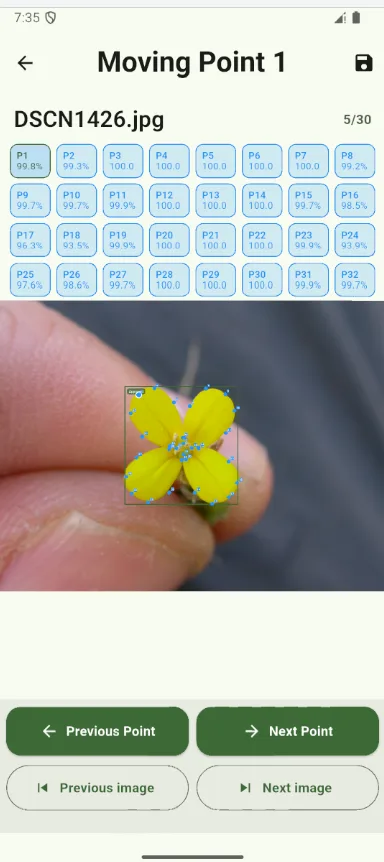
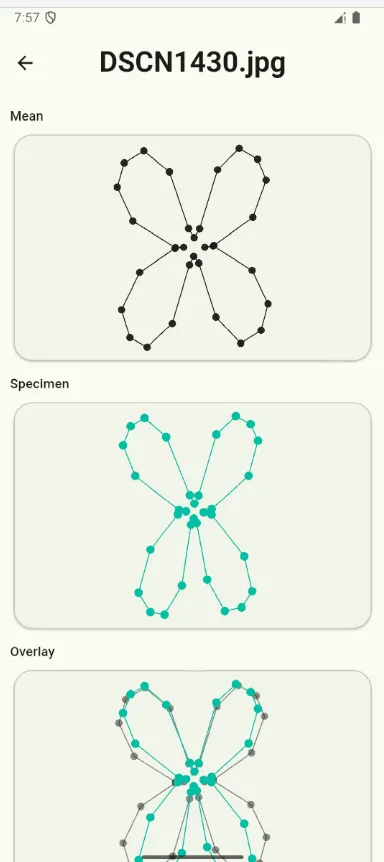
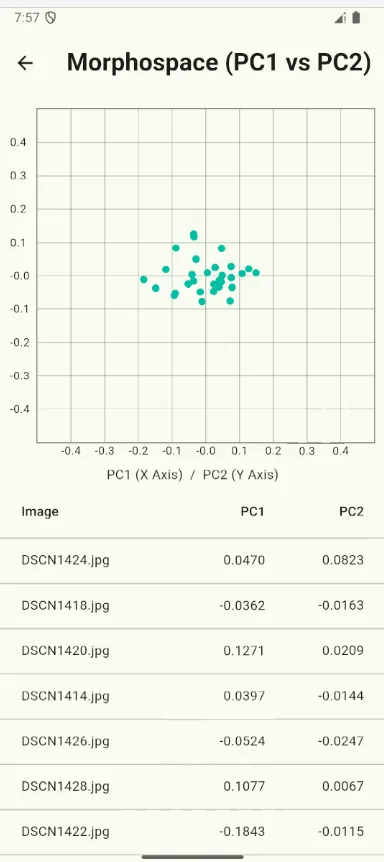
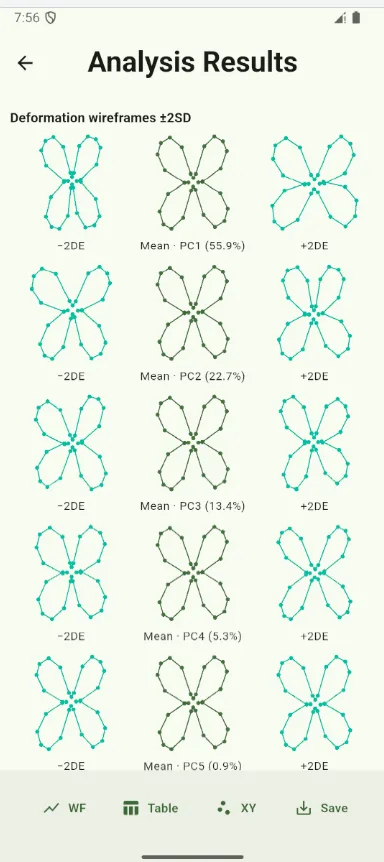
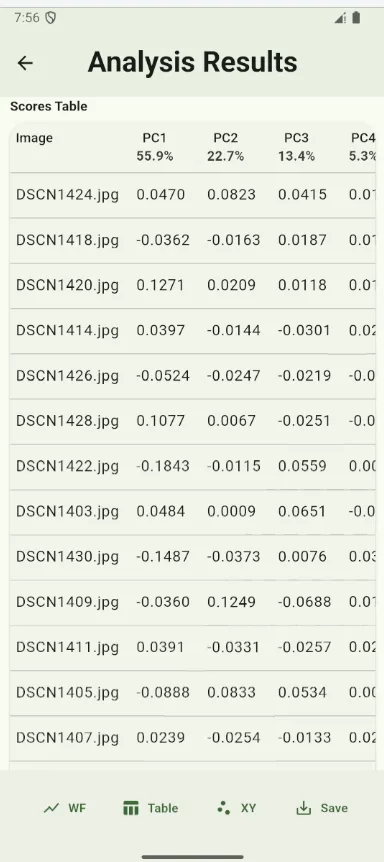
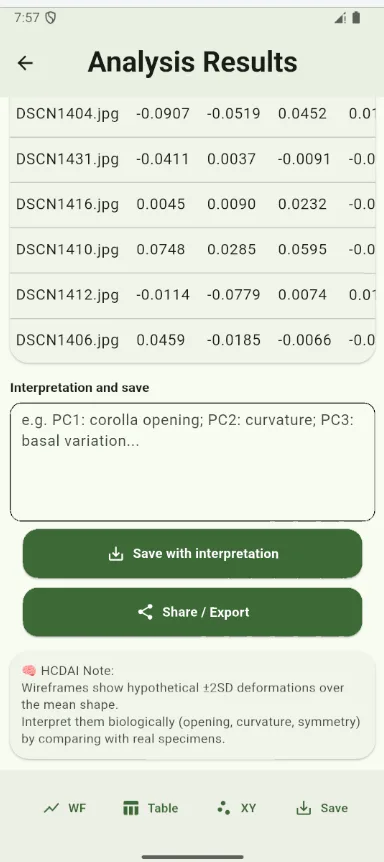
32 AI landmarks on one flower
Validated against experts
Raw AI landmarks, with no human correction, compared with the reference software and with expert manual digitization.
Coming next
Theia 2.0
Theia 2.0 is in development. The app loads model packs, so the same workflow runs on organisms other than Erysimum flowers. A pack holds the two models and the landmark scheme for one structure. You install it on the phone from a file, and the app checks it with a self-test before it uses it.
The annotator
A browser tool to place landmarks on your photographs. The photographs stay on your computer: the page reads them from a folder and uploads nothing. When you are done, you export a landmark file.
- Write your landmark scheme, or click the landmarks in order on the first photograph.
- Once one photograph is finished, each new one opens with the landmarks proposed from the finished ones. You drag them into place.
- Zoom, pan and a magnifier for exact placement, keyboard shortcuts, undo and redo.
- Mark a landmark as missing, or place several specimens on one photograph.
- Your work is saved in the browser as you go.
- Opens and writes TPS, NTS, COCO keypoints, YOLO pose and the CSV of the Theia app.
From your photographs to a model pack
A pipeline turns annotated photographs into a model for the app, in four steps.
Conditioning
Your photographs and landmarks are checked for duplicates, landmarks outside the frame and shapes far from the average, which often means two landmarks were swapped. Whole groups, such as populations, are set aside for the final check. You look at everything before training starts.
Training
One model learns to find the structure in the photograph. A second one learns to place your landmarks on it.
Validation
The model places the landmarks on the photographs set aside. Procrustes, PCA and a Procrustes ANOVA run on your landmarks and on the model's, and the report says whether both lead to the same biological conclusions, as in the paper.
Model pack
Both models, the landmark scheme and a self-test go into one file that you install in the Theia app. From then on it works offline, in the field.
What you would need
- Photographs with one specimen or structure each, all taken from the same view.
- The same landmarks on every photograph, in the same order.
- A group for each photograph, such as population or collecting site.
- A few hundred annotated photographs.
A model for your organism
If your group works with landmarks on another organism and would like to try Theia 2.0, write to us.
Write to uscontact@crisopeya.ioPaper, app, code and data
- PaperMethods in Ecology and Evolution, open accessdoi.org/10.1111/2041-210x.70416
- AppTheia 1.3.0 for AndroidEmail us and we will send it to you
- CodeSource code on GitHub, MIT licensegithub.com/cristobalbragagnolo/Theia
- DataTraining images, validation set and model weightsZenodo, doi.org/10.5281/zenodo.19279346
Android only. Write to us from your email address and we will reply with the app.
Authors
Cristobal Bragagnolo, Andrés Ferreira-Rodríguez, Mohamed Abdelaziz, A. Jesús Muñoz-Pajares
BioChange Network, Department of Genetics, University of Granada, Spain
How to cite
Bragagnolo, C., Ferreira-Rodríguez, A., Abdelaziz, M., & Muñoz-Pajares, A. J. (2026). Theia: An end-to-end edge-AI mobile framework for high-throughput field phenotyping and on-device geometric morphometrics. Methods in Ecology and Evolution. https://doi.org/10.1111/2041-210x.70416